

Introduction
As 2026 begins, Private Capital remain centre stage. However, with heightened competition and more demanding investors, traditional IR and marketing tactics are losing their edge. Meanwhile, budgets are under pressure to deliver more for less.
To bridge this gap, we surveyed GPs and LPs to find out what truly drives investor loyalty. Combining this research with Fin’s deep experience supporting UK Private Capital and numerous GPs, we’ve identified the specific communication mechanics that move the needle.
This report answers the nagging questions behind annual IR planning, helping you sharpen your delivery and build lasting brand preference.
Fin has worked in and around the private capital space for over 30 years, having collaborated with leading GPs on their overarching brand strategy, as well as producing and designing investor facing collateral.
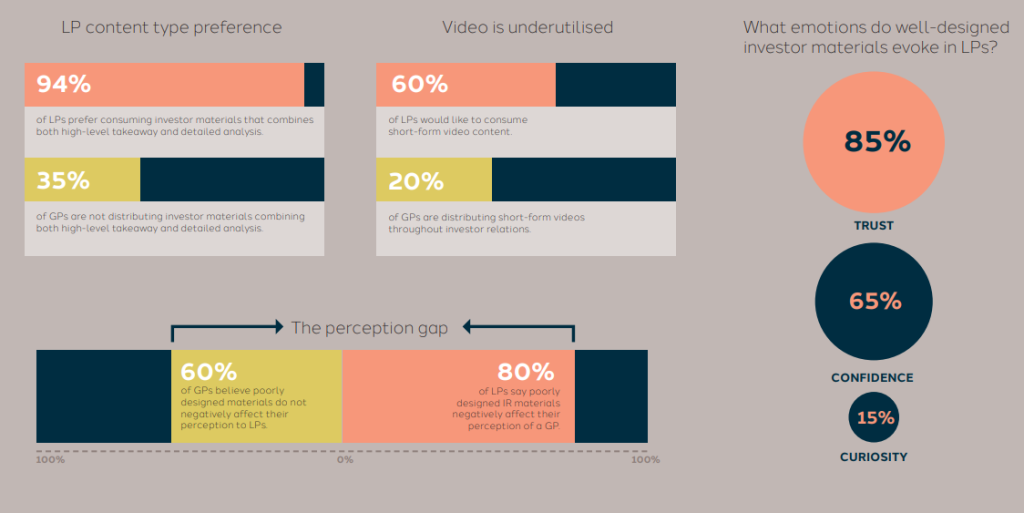
This research paper examines GP–LP communication across fundraising and investor relations, identifying a clear disconnect between the investor materials GPs distribute and LP consumption preferences when evaluating investment opportunities.
As fundraising becomes increasingly competitive, branded communication has taken on greater strategic importance. The design, structure, and distribution of investor materials now play a more meaningful role in differentiating GPs, particularly in an environment where performance dispersion among peers is often narrow.
For managers, successful fundraising is no longer driven by track record alone. LPs review a high volume of materials, and many of the signals that shape preference are processed intuitively as much as analytically.
Managers who deliver original and memorable insight are more likely to stand out, and in doing so, influence LP perception and engagement.
We hope these findings encourage managers to elevate their approach and meet the evolving expectations of next-generation investor relations within private capital.
Who we spoke with
This research paper captures insights from a diverse range of GPs and LPs, spanning different firm sizes, regions, and investment strategies, from marketing and investor relations professionals to C-suite executives.
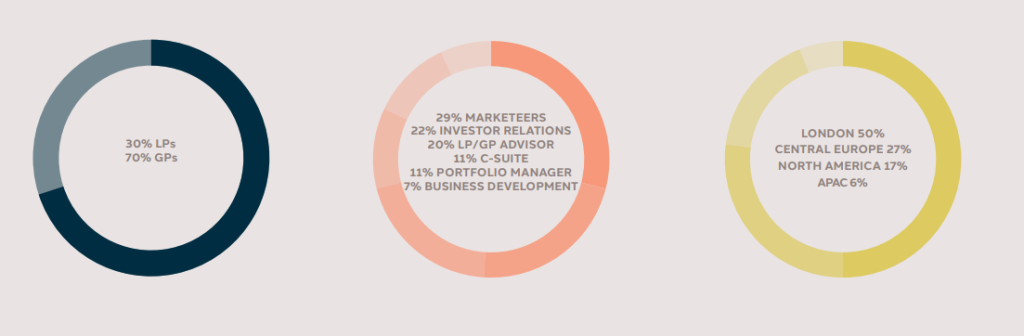
Additionally, we engaged with numerous advisors in the private capital space who contributed further to the survey and participated in roundtable discussions.
“If you’re poorly designing materials, you’re missing an opportunity. You’re putting yourself below firms doing the basics, things GPs often see as secondary, but LPs notice immediately.”
Matt Curtolo, LP/ GP Advisor
Design shapes perception
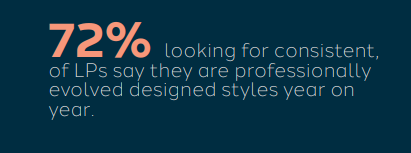
In fundraising, first impressions are everything. How you present your investment philosophy defines how it’s received. After all, people notice the packaging before they read the pitch. During fundraising, when a GP demonstrates personality, through, well-crafted materials, it builds investor recognition. When the performance difference is minimal between competing GPs, strong and well-designed materials can influence LP allocation by enhancing investor perception and memorability. The design, look and feel of investor materials sets the emotional tone for a brand, it doesn’t just share data, it communicates values. It tells LPs, “We take every aspect of our work seriously.”
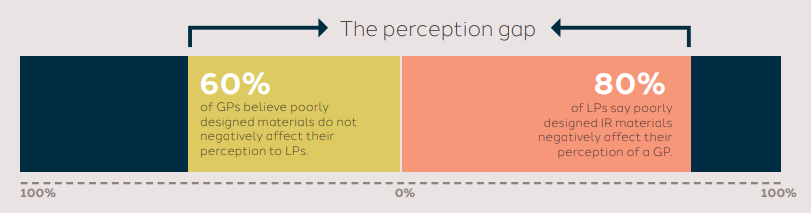
Good design signals integrity, discipline, and commitment, the same qualities LPs seek in capital partners. Design goes beyond aesthetics. It’s about the functionality of materials, digital accessibility and information flow clarity. All of which influence investor confidence alongside other short-term metrics.

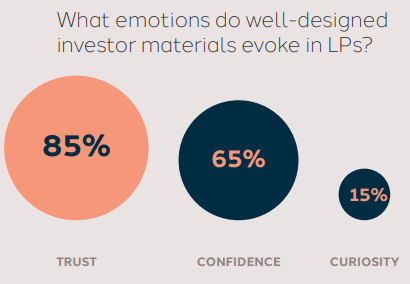
The shift to multi-channel engagement
“LPs are going to favour GPs based on the way they make them feel, through the variety of materials and the levels of communication. Thoughtful commentary that accompanies reports can further build trust and differentiation”
LP Advisor
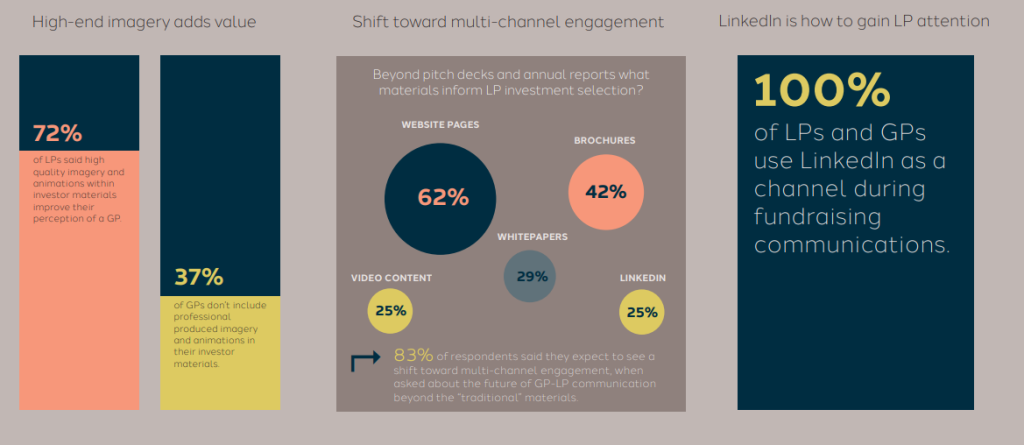
83% of respondents expect multi-channel engagement to define how the next generation of LPs and GPs communicate during fundraising.
Historically, communication between GPs and LPs was largely transactional and periodic. Today, however, investor expectations are evolving fast. LPs now see responsiveness and engagement during fundraising as signals of how the GP will manage relationships, portfolios, and capital after the fund closes.
The era of print is transitioning toward, digital-led storytelling, with 75% of LP and GP respondents engaging solely with digital materials, while 25% consume both digital and print.
86% of LP respondents still rely on annual reports when assessing investments, and 90% review pitch decks. These fundamental materials are now expected to sit alongside more dynamic formats that offer immediate, digestible takeaways. In an industry where investment managers are constantly reviewing content between meetings and on the go, it’s essential to adapt communications accordingly and distribute investor materials that provide concise and easily accessible information.

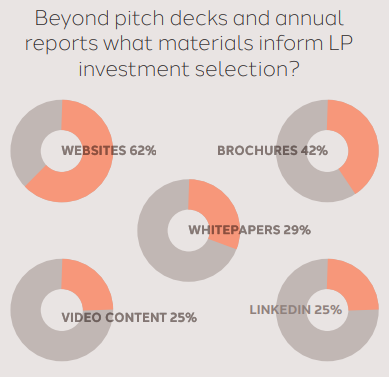
Websites have become a crucial channel for consistent analysis, with 62% of LPs evaluating investment opportunities through this medium. They complement traditional investor-facing materials while keeping analysis centralised and easily accessible.
GPs that provide navigable fund performance, operational metrics, and portfolio information directly on their website offer investors clear, on-demand insights that support more informed decision-making and LP engagement
The rise of video and short-form content
“The shift is not only from print to digital but also from long-form to short-form formats, such as concise videos or snippets that summarise key updates before meetings.”
LP Advisor
Our research indicates a shift in investor communication, primarily driven by changing consumption patterns. Short-form and video content are increasingly leveraged to capture initial LP attention and convey core messages.
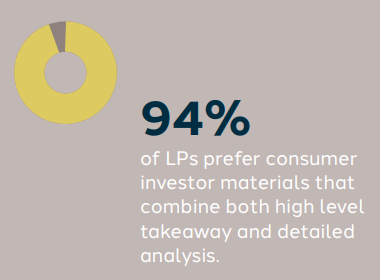
Digital platforms have become a core pillar of investor communication. With 100% of respondents using LinkedIn, which now serves as the front-line for brand visibility, corporate storytelling, and relationship-building within the private capital ecosystem.
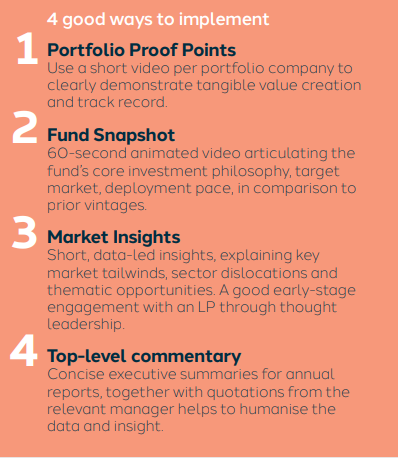
The growing prominence of short-form content and video on LinkedIn is notable. 60% of LPs say they would like to consume short-form video content for its efficiency and clarity. Contrary to this, only 20% of GPs are distributing it. Revealing a clear and actionable gap.
Private capital managers can no longer only rely on a single channel, embracing more accessible formats will deepen engagement with allocators, add greater personality and build a narrative around your firms’ investment approach. Even in more traditional, long-form communications such as annual reports, LP expectations are evolving.
Imagery and animation as a differentiator
“The fact is if you’re an under performing manager, I don’t think you can make up for that with great transparency, and communication. No amount of polish can mask poor performance. But when its close and an LP is comparing, visual memorability becomes a decisive factor.”
Matt Curtolo GP-LP Advisor
GPs who leverage high-quality imagery that reflects a distinct personality create stronger memorability, distinguishing themselves apart from peers where performance differentiation can be narrow.
Consistency across investor materials reinforces brand recognition and recall, enabling LPs to immediately identify a firm across touch points. 71% of LPs consider on-brand, cohesive materials to have the greatest impact on building trust during investment evaluation. This is particularly critical in a multi-channel environment, where materials are often consumed selectively and out of sequence.

The most effective investor communication combines clear, disciplined language with visuals that support a coherent narrative. Together, these elements build familiarity, reinforcing trust, and position the manager as a credible, “safe pair of hands” in an increasingly competitive fundraising market.
For GPs whose investment strategies are centred on intangible or conceptual assets, abstract visuals paired with disciplined corporate storytelling and data-driven narratives offer a unique opportunity to communicate complex ideas. This approach not only differentiates a firm from industry clichés and overused stock imagery but also reinforces positioning as a unique, forward-looking manager